First rule: read the room
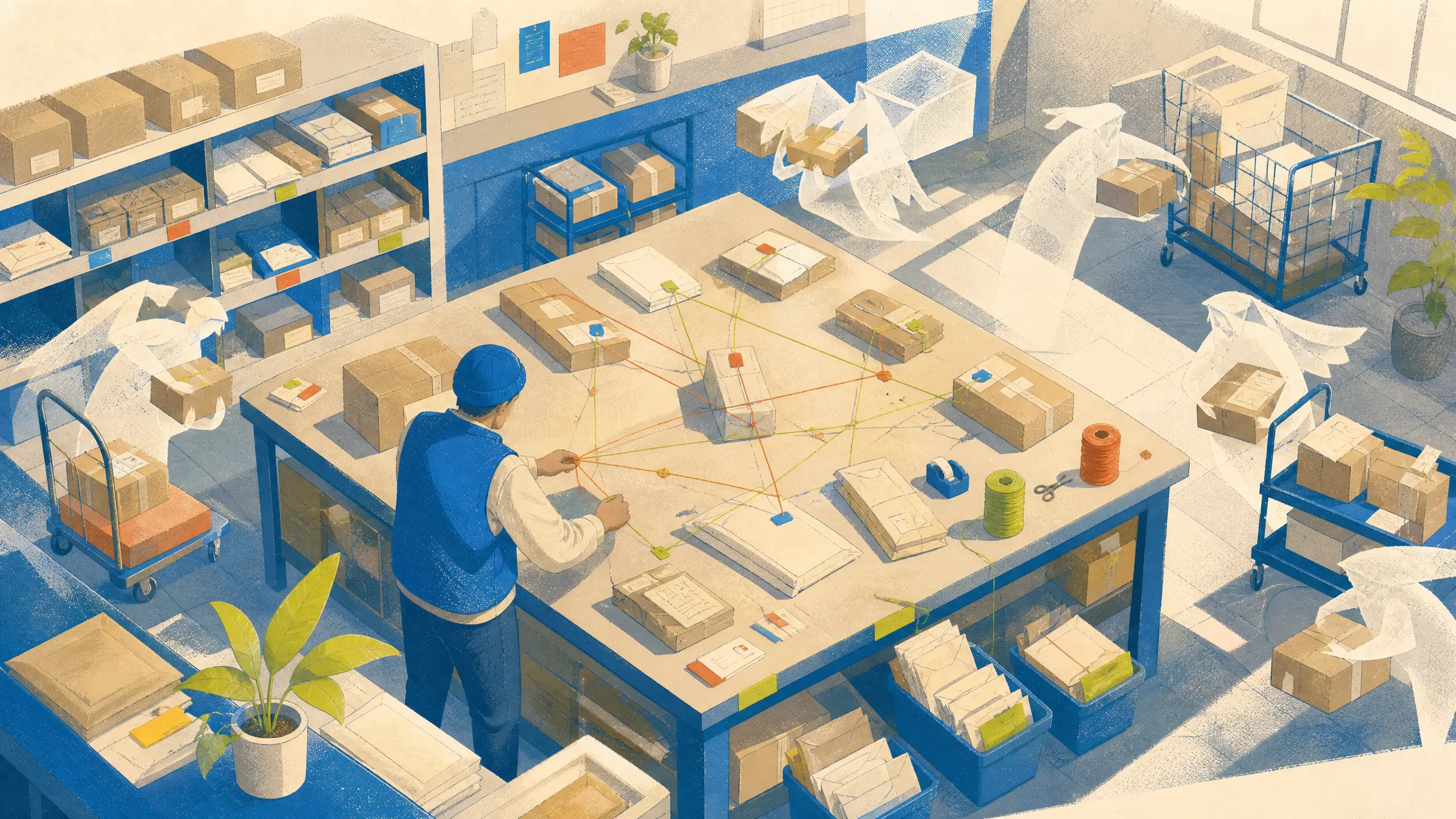
Parcel Ghosts teaches with clutter. The sorting floor contains six coloured routes, three loading clocks and a wall of addresses that shift whenever translucent envelope spirits pass through them. The temptation is to follow the spirit. Do not. Begin by checking which shelf labels remain unchanged. Stable information tells you what kind of distortion has entered the room.
Blue spirits reverse distance: near addresses become far and far addresses become near. Peach spirits swap building functions, turning a bakery delivery into a library route while keeping the street intact. Pale green spirits affect time windows. Their paths are decorative; their colour and the first label they cross are the useful facts.
Build routes from anchors
Every district contains one anchor address that cannot move. It is printed with a small square rather than a circle and remains valid through every haunting. Start each route there, then add parcels whose street or recipient shares a verified relationship. Avoid solving packages one by one. The game rewards chains because each confirmed stop reduces uncertainty for the next.
When two routes appear equally short, compare loading clocks. A route that leaves three minutes later can still arrive first if its trolley crosses fewer spectral junctions. Time is part of distance in Parcel Ghosts, and the route planner shows this only after you pin at least two stops.
Use mistakes as labels
A returned parcel is not a punishment. Its stamp records which address component failed: district, function, recipient or window. Keep one deliberately uncertain parcel at the end of a route. If it returns, the failure can identify the active ghost more efficiently than waiting for another full sorting cycle.
This is the game's central generosity. Wrong answers produce structured information. The score screen cares about total handling time, but the campaign never locks progress behind perfection. A messy route can be a very good experiment.
What not to optimise
Do not chase gold time on the first pass. Later equipment changes trolley capacity and makes several early routes fundamentally different. Do not memorise fixed addresses either; the third chapter begins combining distortions, and rote solutions fail immediately. The durable skill is recognising which information can still be trusted.
Most importantly, leave the optional “Unclaimed” parcels alone until the story introduces echo sorting. Their strange labels are not secret codes you are expected to crack early. Parcel Ghosts is at its best when its systems unfold in sequence. This guide should make the rules visible, not remove the pleasure of discovering what they can do together.
A ghost is not asking where a parcel goes. It is showing you which part of the address has stopped being true.